We’ve gotten mostly dug out from the biggest blizzard to hit the area in more than 30 years. It began in earnest Tuesday and, by noon yesterday, had dumped 15″ of snow. Of course, the snow didn’t fall in a vacuum…it was carried about by 40+ mph winds. We don’t have a snowblower, just shovels, so it was more than 3 hours of shovelling to open our 50-foot driveway.
The roads need to be finished, which means the plows will dump a bunch more snow in the driveway between now and tomorrow night…and there’s still the walkway to the front door to clear. But that will mean digging through 4-foot drifts. So for now, we’re entering the house through the garage and waiting for spring.
With snow absolutely everywhere, let’s spend one more evening discussing a rather unusual engagement that took place in the Winter War.
Colonel Aaro Pajari’s successful raid on the 7th had a couple of side-effects. First, it gave a boost of confidence to the Finnish troops involved as well as those in the area. Other units picked up on Pajari’s tactics, using them to great effect against the superior numbers of Red Army soldiers. Second, it caused the Russians to become far more wary than was really necessary. Sniper fire and well-entrenched Finnish platoons could tie up battalion- and regimental-sized forces. The raids had replaced the Russian arrogance with gross hesitation.
Finnish Colonel Paavo Talvela had experienced this first-hand. His troops, having retreated for the first week of the War, had begun a series of jabs against the Russian 155th Division. With the enemy now off-balance and nervous, Talvela planned an all-out offensive for December 11th. The Red Army, however, had other ideas.
As the clock struck 11:00pm on December 10, 1939, an entire Soviet battalion marched, undetected, through dense forests and attacked Talvela’s left flank not far from Tolvajarvi (and not far from the scene of Pajari’s raid). There were almost no troops there, just field kitchens, cooks, a few personnel, and some medical units, which were quickly driven off.
But the cooks left behind huge vats of sausage soup simmering over the fires, which the attackers smelled. They stopped, looked around for a moment, then grabbed spoons and bowls and helped themselves. The momentum of the attack was broken.
Colonel Pajari, still in the Tolvajarvi area, quickly assembled the scattered cooks, medics, and quartermasters into a 100-man force and commenced a counterattack. The subsequent fight, named the “Sausage War”, was brutally vicious, with hand-to-hand combat and knife fights waged around steaming pots of delicious dinner.
When the attacks subsided in 11th’s morning hours, the kitchen’s soup kettles were mostly empty, having been riddled with gunfire. The ground was strewn with soldiers, temporarily warmed by a purloined dinner, now frozen in death. Many still had mouths full of sausage. Only a few dozen Red Army soldiers from the battalion returned to their lines.
Recommended Reading: A Frozen Hell
Posted in Scandanavia, World War II (1939-1945) | Tagged 1939, Colonel Paavo Talvela, Finland, Lt. Colonel Aaro Pajari, Sausage War, Tolvajarvi, Winter War | Leave a Comment »
The loss of Fort Washington in mid-November and the subsequent surrender of Fort Lee meant that the Colonies had not only lost control of Manhattan and the Hudson River, but they had lost New York altogether. General Washington’s forces were bedraggled, defeated, and in full retreat.
For the last couple of weeks (since the Mahattan disaster), the order of the day was to avoid all major conflicts with the British Army, which was following close behind. Instead, the Continental Army engaged in rearguard actions that were meant to harass the Redcoats and keep them constantly uncomfortable while, at the same time, presenting little risk to the men.
As Washington’s men approached the Raritan River near New Brunswick, New Jersey, their General gave thought to turning and facing his pursuers. But the condition of his forces put paid to that hope. So other than a heavier-than-usual rearguard action, the trudging retreat in the cold and snow continued.
On December 8, 1776, his forces crossed the Delaware River and entered Pennsylvania, effectively giving up New Jersey without a fight.
It’s not recorded anywhere, but one is left to wonder if General Washington looked back across the ice-choked Delaware to the New Jersey shore and said, MacArthur-style, “I shall return.”
Indeed, three weeks later, with the bells of Christmas still ringing, Washington’s forces would re-cross the Delaware River attack the still-chemically-altered British and Hessian troops camped at Trenton.
But on this day, morale in the Continental Army was at as low a point as it would be during this increasingly difficult struggle for freedom.
Recommended Reading: Washington’s Secret War
Posted in The Revolution (1775-1783), United States | Tagged 1776, Continental Army, Delaware River, General George Washington, New Jersey | Leave a Comment »
It was a dark, cold, and moonless night as Lt. Col Pajari moved his men into position. Of course, in Finland, December was mostly dark and always cold. But while the winter of 1939 was as dark as any given winter, the weather was unusually cold, with temperatures that would hit -30°F regularly. There was plenty of snow on the ground, but there hadn’t been much in recent days, which is what the Finns had really wanted.
It would have served to slow down the Soviet Red Army, which had come storming across the border the week before. Almost everywhere the Finnish Army had fallen back and, while the Soviets had already taken heavy losses, they had also taken the port of Petsamo in the frigid north, and were attacking at numerous points between the port and the Mannerheim Line on the Karelian Isthmus down south.
Carl Gustav Mannerheim, who had resigned his post days before the outbreak of war, was immediately called back to action. He was surprised by how heavy the attacks had been in the heavily-forested regions north of Lake Ladoga. The Russians were pushing toward Oulu, and if they reached it, Finland would be cut in half.
Mannerheim’s troops needed a victory…any victory, to get a boost of confidence. Pajari’s men provided it in the early morning hours of December 7, 1939.
Crossing frozen Lake Tolvajarvi in the dead of night, his Fourth Company (made up of little more 150 men) attacked an entire regiment of Russian soldiers. Bivouacked near a road and in a depression, they presented a fantastic target to Pajari’s men, with their dark uniforms contrasted with the white snow and highlighted by the massive fires. Fourth Company quietly lined up on the ridge and opened fire at 2:00am. Within minutes, it was over. Not a single Russian soldier remained alive, and not a single Finnish soldier had so much as been wounded.
As Fourth Company was lost to the frigid morning darkness, two other Red Army regiments, panicked at the sound of gunfire and camped nearby, had mistakenly engaged one one another and were attempting to wipe each other out.
Mannerheim’s men had nowhere near the firepower to compete against the forces assaulting his country. So it would be these small “slash-and-dash” operations, and the tremendous success they acheived in the conflict’s first two months, that would come to characterize the Winter War.
Recommended Reading: A Frozen Hell
Posted in Scandanavia, World War II (1939-1945) | Tagged 1939, Carl Gustav Mannerheim, Finland, Lake Tolvajarvi, Lt. Colonel Aaro Pajari, Winter War | Leave a Comment »
During the week, I eat breakfast at my desk and it ususally consists of:
1 cup pistacchios (they’re super-healthy)
1 serving of fruit (yogurt/applesauce/etc…)
1 multi-vitamin & 2 fish oil pills
Water
Sounds exciting, doesn’t it? You’re right, it’s not exciting…not in the least. But it tastes good and it’s healthy.
Weekends are different. My wife might be the best cook I know (and I’m not just saying that), and sometimes she’ll whip up something delicious, like French toast, or a breakfast pizza…and it’s awesome, or maybe an egg scramble with bacon, toast, and sausage. Other times, I’ll make oatmeal or oat bran cereal…and don’t forget the flax!
But on occasion, breakfast takes a different form…restaurant food. And if breakfast is coming from a fast food place, one and only one thing tops my list…
A Croissan’wich from Burger King. The croissant is light and flaky with a bit of buttery sweetness. It also leaves less oily residue on my fingers than a traditional biscuit And there’s that slight crunch when I first bite in. And then there’s all the breakfast goodies inside. And Burger King’s idea of “having it your way” means there are options. Egg?…of course. Cheese?…definitely. And the protein part…mmm…MMMM!!!! Should I pick the tasty bacon, or maybe the ham? Either is great, but that would leave out the sausage.
When I buy them, I’m usually in the car, so a Croissan’wich with bacon is a little less forgiving. You know how it is…you’re driving in morning traffic, you take a bite and the whole piece of bacon comes out, dragging the melted cheese, which is stuck to the egg.
Now I have to make a choice. Either I have to try to stuff all the innards of the rapidly disintegrating sandwich into my mouth (which already is full of food), or I have to let it all fall in my lap, or I use my driving hand to catch what’s falling. Usually it’s a combination of all three.
So now my breakfast is risking the lives of other drivers who are busy typing text messages, talking on their cell phones while waving their hands around, messing with the new GPS-thingy they just bought, or balancing their checkbooks. That’s clearly not very considerate of me.
So I avoid the bacon Croissan’wich, and order one with ham/egg/cheese and another with sausage/egg/cheese.
Even though I’ve never been there, I’m a big fan of Heaven. My wife talks about the place in terms of chocolate and peanut butter (she’s highly allergic to both). I’m not sure that we’ll ever need to eat in Heaven, because hunger is your body lacking something and our bodies won’t lack for anything there. But if we do, I’m hoping Burger King Croissan’wiches are on the menu. After all, they are heavenly.
Oh…a history lesson. The first Burger King opened in Miami on December 4, 1954.
Posted in Twentieth century (1901-1960), United States | Tagged 1954, Breakfast, Burger King, Croissan'wich, Florida, Heaven, Miami | 6 Comments »
The German air raid on the Italian port of Bari would have, under normal circumstances, occupied a minor space on the shelves of history. It is notable that the attack, which took place on the evening of December 2, 1943 and involved 105 Junkers Ju-88 bombers, caught the Allies completely off guard and achieved a ”Pearl Harbor”-esque level of surprise.
But Bari was primarily a supply port and depot, so the targets were hardly as glamorous as Battleship Row, with capital ships lined up like so many immobile ducks in a shooting gallery. Still, there were a lot of supply ships and merchantman moored about. The Germans succeeded in hitting two ammunition ships and, as we would suspect, they exploded in titanic fashion. An oil pipeline was also severed, dumping fuel oil into the harbor. Once it caught fire, the harbor became a sheet of flame, igniting other merchant and supply ships. In all, nearly 20 ships were destroyed and the port was closed for three weeks.
A good tally for the Germans, to be sure, but really not enough to make it stand out on its own. So what makes this particular event different?…what gives it more historical “shelf space” than others?
The SS John Harvey.
The John Harvey was a Liberty ship that arrived in Bari with a special cargo…a classified top-secret cargo. In her holds were 2,000 bombs carrying mustard gas. Used extensively in World War I, this chemical agent caused terrible burns when contacting the skin and respitory damage when inhaled. The use of chemical weapons had been outlawed in the 1920’s, but the military feared that the Germans, in the face of defeat, might resort to unconventional weapons of their own. The John Harvey was an Allied “contingency” plan…and it back-fired badly.
The John Harvey was one of the victims of the raid, and as she exploded and sank, some of the the mustard gas was released. It mixed in with the oily water, which coated sailors as they struggled for shore. It got into the air, mixing with the smoke of the fires and passing over the city of Bari.
Within 24 hours, hundreds of civilians were showing up at medical facilities with strange burns, acute illness, and blindness. Medical staff found it increasingly difficult to handle to work, not only because of the volume of people, but also because many of them (having been exposed to the sailors and wounded) were now being affected by the agents.
The Allied High Command kept quiet, desperately wanting to keep the mustard gas a secret, which forced medical personnel to “fish in the dark” for the causes of the symptoms. It wasn’t until weapons experts were brought in and began examining the situation that the source was discovered.
And it would be another three months until the news was made public. But by then, hundreds (and probably thousands) of people had died from exposure. It’s likely that many deaths were not counted simply because so many people fled the city to escape the “mystery disease” that burned, blinded, and killed.
The final reports were classified by the U.S. until the late 1950’s, but the British documents were actually sanitized, changing the cause of death from World War II’s only release of chemical agents to “burns due to enemy action”. It wouldn’t be until the 1980’s that the British admitted the truth.
Recommended Reading: The Day of Battle
Posted in Mediterranean, World War II (1939-1945) | Tagged 1943, Bari, Italy, Junkers Ju-88, Liberty Ship, Mustard Gas, SS John Harvy | 2 Comments »
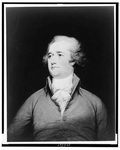
Alexander Hamilton’s tenure as the country’s first Treasury Secretary was a stormy one. In those 5 years, he had overseen the creation of America’s financial system and a national bank. He had witnessed the first stock offering and, a few months later, the first stock market crash. He had created a system by which the fledgling U.S. Government could pay down its debts and establish good credit with foreign powers. Ultimately, he set in motion (in the 1790’s) many of the financial principles we still utilize today.
Alexander Hamilton had also made quite a few enemies.
His views (and his actions) produced, in the minds of his opponents, a stronger central government than was necessary or desired, and it brought him into sharp debate with them. These “anti-federalists” (those against a strong federal government) argued long and loud against the ”federalists”, claiming their final plan was a return to the hated monarchy. And while Alexander Hamilton was not the leader of the Federalist party – that honor went to President Washington and Vice President Adams – Hamilton became the poster-child for all that was wrong with their philosophy. He was the Anti-Federalist whipping boy.
His opponents scoured the “Hamiltonian landscape” for anything untoward…any kind of official misconduct that could form the noose of his political lynching. For several years they peered into the records. But Alexander Hamilton, as many of you know, was painstakingly precise with the books. Any appearance of official misconduct was abhorrent to the young Secretary. Anti-Federalists pored in vain over the ledgers and found nothing…until 1794.
In the spring of that year, they discovered what they thought to be the smoking gun. Back in 1790, Congress had set aside monies to be used to pay overseas creditors. Hamilton had diverted some of the funds to domestic spending, after consulting with the President…but Hamilton had no evidence to prove the meeting took place. President Washington was consulted and, 5 years after the fact, had no evidence of the meeting, either…and no recollection that it had taken place. The President was quick to add that, if the meeting had taken place, he was sure he would have advised Hamilton to do what was consistent with the Congressional directives of the legislation.
To some degree, the President had thrown his Secretary to the wolves.
The formal inquiry turned up Hamilton’s misconduct (which we’ll visit in a couple weeks), but none of it was official. Hamilton ended up being exonerated of any misappropriation. The damage, however, had been done. The Secretary felt betrayed. The character of his office had been called into question, and that was anathema to Hamilton. And while he and the President would remain on good terms (Washington asked Hamilton to compose his Farewell Address just two years later), any blot on his integrity (real or implied) was too much.
But there was more. Hamilton had just return from an exhausting trip west with the President as head of the army. Their mission to squelch the Whiskey Rebellion had been successful, but had served to make Hamilton more hated among the “drinkers of hard liquor”, so much so that he required a six-man escort. And Eliza, his devoted wife, had just suffered a miscarriage, which Alexander largely blamed on the stresses of his contant absence.
On December 1, 1794, America’s first Treasury Secretary announced his departure, effective January 31, 1795. In accepting his Secretary’s resignation, Washington spared little of his most effusive praise. Thinking back over their strong 20-year working relationship, the President cast aside the rantings of Jefferson and the ravings of Madison and wrote, “In every relation which you have borne to me, I have found that my confidence in your talents, exertions, and integrity has been well placed. I the more freely render this testimony of my approbation, because I speak from opportunities of information which cannot deceive me and which furnish satisfactory proof of your title to public regard. My most earnest wishes for your happiness will attend you in retirement.”
Recommended Reading: Alexander Hamilton
Posted in Constitutional period (1789-1809), United States | Tagged 1794, Alexander Hamilton, Anti-Federalist, Federalist, President George Washington, Secretary of the Treasury | Leave a Comment »
In the days following the end of negotiations between Finnish diplomats and Joseph Stalin, the citizens of Finland began to relax just a bit. It was no secret that their army stood little chance…correct that…no chance against the military tsunami that the Soviets could unleash, and the Finns had initially prepared for the inevitable attack. But to this point, none had come, and that was good enough for them.
They knew their sovereignty was recognized by the world, and Stalin must have realized that, too…hence his inaction. And what’s more, the Finns were convinced that, should the Soviet hordes set foot upon the sacred Finnish soil, Western countries would flock to Finland’s defense.
Carl Gustav Mannerheim believed otherwise. As Finland’s leading military man, he begged the Finnish government to reopen negotiations with the Soviets, claiming they would simply take what they wanted in the end. His reports of Soviet forces drifting westward were, in his mind, a most ominous portent. He even moved his own forces on the Karelian Isthmus (the main area of contention) back as a show of non-aggression. On the 26th of November, however, several artillery shots were reported landing about half a mile inside the Russian borders near the village of Mainila. History would show that they were fired by the Red Army, but as you would expect, the Soviets blamed the Finns. Mannerheim wasn’t stupid (he knew how this would play out), and his anger at the ”Finnish stubborness” boiled over. The day after the “Mainila Shots”, Gustav Mannerheim resigned from the army.
In the Kremlin, Stalin had spent the last few weeks assessing his military options. When questioned, his generals assured him that Finland would be a pushover. Nikita Khrushchev, then a Politburo member, described the general consensus when he said, “All we had to do was raise our voices a little bit and the Finns would obey. If that didn’t work, we could fire one shot and the Finns would put up their hands and surrender.”
The Soviet dictator also wanted to know if the Communist contingent among Finnish workers would rise up when the fighting started. He was assured by his sources that they would. But one must now consider the backdrop of the time when looking at this “information”. Clearly, people with any loyalties to Trotsky, the old Czarist regimes, or any other view differing from Stalin were receiving fatal gunshot wounds. By the ten of thousands they were dying…Khrushchev himself narrowly escaped the executioner’s pistol. So when Stalin wanted “the scoop”, those around him told him what he wanted to hear, regardless of whether there was any truth or research behind it. “Will the Finnish Communists join the Red Army?”…“Why, of course they will.” Stalin’s reign of terror was one of his own worst weapons.
So it comes as little surprise that the first bombing run carried out against Finland came at 9:20am on November 30, 1939. The single plane dropped thousands of leaflets over Helsinki which urged the workers to rise up against their leaders and overthrow the government. That plane then dropped a couple bombs to get everyone’s attention, have them run out of the factories, and read the notes.
Seventy minutes later, a group of bombers arrived over Helsinki, this time with real bombs. Simultaneously, the Red Army invaded Finland all along the border, from Petsamo in the far frozen north to the southern edge of the Karelian Isthmus in the still-very-cold south. In all, more than 25 divisions set off into Finnish territory that was protected by a total of 8 divisions and a collection of reserve and Civic Guard troops.
It did not shape up to be much of a contest, but wars are not fought on paper.
Recommended Reading: A Frozen Hell
Posted in Scandanavia, World War II (1939-1945) | Tagged 1939, Carl Gustav Mannerheim, Helsinki, Joseph Stalin, Karelian Isthmus, Nikita Khrushchev, Petsamo, Winter War | Leave a Comment »
The decision by Vichy French forces to lay down their arms in North Africa didn’t play well at the top of the German military. The announcement, coming on November 11, 1942, was immediately followed by the German occupation of Vichy France.
Nazi forces rolled through Vichy (which comprised the southeast half of France) and arrived at Toulon, a major port that opened into the Mediterranean Sea. It was also home (and still is, for that matter) to a large portion of the French fleet, which interested the Germans greatly. Docked in Toulon were 3 modern battleships, 7 cruisers, 18 destroyers, nearly 2 dozen submarines, and dozens of smaller auxiliary boats, tenders, and tugs.
It presented a nice addition to the Germany Navy, and a huge boost to their presence in the Mediterranean. At that point the Germans began negotiating with Admiral Jean de Laborde, trying to get him to surrender the fleet peacefully.
Simultaneously, French Admiral Darlan was trying to get Laborde to sail the fleet out of Toulon and to the North African coast (not all that long of a journey) and add its firepower to the Allied side of the ledger. The French ships stationed at Casablanca had foolishly decided to fight the incoming Allied forces and were soundly defeated. The addition of the ships from Toulon would be most welcome.
For two weeks the negotiations continued, with the Germans and Allies each trying to win the day.
In the early morning hours of November 27, 1942, German patience ran out and SS panzer troops stormed the gates of Toulon’s naval base. Immediately, Laborde gave the “Scuttle, scuttle, scuttle!” order. And in one of the greatest acts of self-sabotage ever, the French sailors complied.
The sea cocks were opened and the waters of the harbor poured into the ships. The engines were destroyed, along with the instruments, and the base at Toulon became a giant junkyard. One by one, the ships got lower in the water, the fires set in the engine rooms eventually succumbing to the incoming flood.
In all, more than 70 vessels were sunk. The 3 battleships, the 7 cruisers, 15 of the 18 destroyers, a dozen submarines, most of the torpedo boats, and all the tugs.
The immense frustration felt by Darlan (and many others) was tempered by General Eisenhower who, always the diplomat, reminded everyone that keeping such a powerful force out of German hands was a victory of sorts.
I wonder if anyone was brave enough to tell the good General that it wouldn’t take many of these victories to cost the Allies the war.
Posted in Mediterranean, World War II (1939-1945) | Tagged 1942, Admiral Jean de Laborde, President Dwight Eisenhower, Toulon, Vichy France | Leave a Comment »
I hope you all have had a wonderful Thanksgiving. Ours was very good. Our son, his wife, and their children came over, entertained us, and helped us eat enchiladas and all the trimmings. I drank too much soda and ate too much, but all in all, a great day.
As the food settles, I’m going to do something most of you have never done…
I’m mentioning Pearl Harbor and Mount Yushan in the same sentence.
Prett daring, eh?
Actually, it’s not as provocative as it seems, as we’ll see.
On November 26, 1941, the Kido Butai left Kyushu in northern Japan. It’s destination?…Pearl Harbor. Better known as the Japanese 1st Air Fleet, Kido Butai was led by Admiral Chuichi Nagumo. Comprised of six aircraft carriers with more than 400 aircraft, two battleships, numerous escorts, and 23 submarines, it was the largest naval fleet in the world at that time. It’s job was to attack the U.S. fleet stationed at Pearl and do enough damage to knock the U.S. out of the war before it could get started.
But before the fleet could commence its attacks, it needed to get the green light from higher up. It would come in the form of a coded message, and that’s where Mount Yushan comes in.
Mount Yushan is the tallest mountain…on the island of Taiwan. But in 1941, Taiwan was not a sovereign nation (and some still believe that to be true). Having been annexed in 1900, Taiwan was under Japanese control, and Yushan had been named Niitaka by the new owners.
So as the 1st Air FleetAdmiral pulled out of port, Admiral Nagumo awaited the coded message that would come from his superiors. Its contents, “Niitakayama Nobore” (“Climb Mount Niitaka”), would give the fleet permission to complete its mission. But against the day that the final order came, the trick would be to keep this massive fleet a secret as it moved south as east. That would prove to be a most delicate task.
Recommended Reading: At Dawn We Slept
Posted in Pacific, World War II (1939-1945) | Tagged 1941, Admiral Chuichi Nagumo, Kido Butai, Kyushu, Mount Niitaka, Mount Yushan, Pearl Harbor | Leave a Comment »
Usually, when I cover a topic, the search for related artwork or photos is relatively easy. But when the subject is the USS Liscome Bay, such is not the case. There are very few photos available. And that’s because the life of Liscome Bay was short, and it was a life that ended quickly…and violently.
She was known as CVE-56 in Navy-number-speak, as was classified as a Casablanca-class escort carrier. That means she was about half the size of a conventional carrier, and carried a smaller compliment of men, aircraft, and armor. But its smaller size also meant it was cheaper to build and could be finished in much less time than bigger flattops. So it’s no surprise that, in the 20 months that Casablanca-class carriers were built, a staggering 50 examples were built…more than any other carrier class ever. The St. Lo, which we just talked about last month, was a Casablanca-class carrier.
Normally, escort carriers were fairly slow got the more mundane jobs like supporting land-based activity such as close air support and interdiction strikes. Casablanca-class carriers were moderately fast (capable of 20 knots), but were still considered too slow for major fleet action (bigger carriers, battleships, and such could all make 30 knots or more). Still, they got to mix it with the big boys on occasion, as Taffy 3 did in Leyte Gulf.
But St. Lo and Taffy 3 and Leyte Gulf were in October of 1944, and this was November of 1943…almost a year earlier. At this point the Navy was thinking about the Philippine Islands (and Leyte Gulf and all that), but the work at hand involved the Gilbert Islands, specifically those around Betio…Tarawa. Concurrent with the landings at Tarawa were the landings on Makin, a small group of islands about 100 miles south. The small Japanese garrison on Makin (less than a 1000 men) was expected to fall quickly…a day, maybe two.
Like most Pacific operations, however, it didn’t play out that way. Cleaning up Makin took 3 full days. And of course, this ground operation was supported by the escort carriers…in this case, the Liscome Bay, Corregidor, and Coral Sea. Having just been commissioned in August, our subject was brand new, carrying 28 aircraft and more than 900 men.
In the early morning (just after 5:00am) of November 24, 1943, she was preparing to launch aircraft when one of the ship’s lookouts yelled, “Here comes a torpedo!” Indeed, the Japanese submarine I-175 had arrived the day before and selected the Liscome Bay as her target.
At 5:10am, a single torpedo struck the aft engine room and exploded. But the real catastrophe occurred when the torpedo remnants plowed into the aircraft bomb magazine. When ammunition cooks off, it does so in dramatic fashion, and the Liscome Bay was no exception. Witnesses said the ship was just a massive ball of orange flame, and bits of ship hit other task force vessels nearly 3 miles away. At 5:33am, Liscome Bay slipped beneath the waves, carrying with her nearly 650 sailors and officers.
The operation on Makin Atoll was intended to be a relatively clean one-day operation. One explosion, however, had caused U.S. casualties to achieve near parity with the Japanese.
Recommended Reading: Tarawa: A Hell of a Way to Die
Posted in Pacific, World War II (1939-1945) | Tagged 1943, Gilbert Islands, I-175, Makin Atoll, St. Lo, Tarawa Atoll, USS Liscome Bay | Leave a Comment »
“Fortress Stalingrad” had a grandiose sound to it, but the title was deceiving. German General Friedrich Paulus knew that his 6th Army was in serious trouble. What a difference 5 days made! Back then he believed his Soviet enemies had their backs against the proverbial wall and that Stalingrad was nearly his.
But a massive Soviet counterattack was rapidly changing the situation. Launched in the dim morning hours of November 19th, Operation Uranus crashed into the weakened German flanks with devastating effect. By the end of that first day, the Romanians (manning the flanks) had suffered more than 55,000 casualties. The next day saw the 1st Romanian Armoured Division eliminated and the 22nd Panzer Army badly mauled.
The flanks largely collapsed, leaving the Soviets only modest resistance on their path to encirclement. Paulus, seeing a horrific disaster unfolding to his back (the west), released his own 3 Panzer divisions, but a lack of fuel and ammunition – keep in mind that supply lines, which were incredibly long, came from the west – made their efforts much less effective.
On November 23, 1942, Paulus’ nightmare became reality when Soviet forces, which had stepped off from both north and south of the city, met up at Sovietskiy, 30 miles west of Stalingrad. The encirclement, although tenuous, was complete. What was left of the Romanian Third Army (more than 25,000 men) was forced to surrender…the Romanians suffered nearly 90,000 total casualties in four days of brutal fighting.
Inside the pocket lay Stalingrad, General Paulus, and his forces. They comprised remnants of the Romanian Fourth Army, the Fourth Panzer, and (of course) the German Sixth Army…nearly 270,000 men. It was at this point that Paulus stood his best chance of escape from his “trap on the Volga”. Soviet forces had yet to consolidate their positions, Field Marshal Erich von Manstein was pushing to reinforce the destroyed flanks, and Paulus still commanded a formidable force with substantial artillery. A breakout, while not anything close to victory, would have prevented certain destruction.
But it was at this point that the German High Command did itself in. Hermann Goering foolishly boasted that his Luftwaffe could keep Fortress Stalingrad supplied from the air…even though Wolfram von Richthofen’s 4th Air Fleet only had half the aircraft it needed. And Adolf Hitler, blinded to all reality but the now vanishing hope of capturing Stalingrad, bought Goering’s plan and ordered Paulus to hold his ground. One can almost hear Goering’s arrogant assurance and the remaining Generals giving each other those fleeting glances of dismay.
However, in speaking of the German failures, one should not minimize Soviet Marshal Georgy Zhukov’s genius in launching Uranus. I’ve mentioned Chris Bellamy’s book Absolute War on several occasions, and he is effusive in his praise…and rightly so.
He writes, “Along with the Carthaginians’ encirclement and annihilation of the Romans at Cannae in 216 BC, Zhukov’s destruction of the Japanese at Khalkin Gol in 1939, and Schwarzkopf’s Hail Mary of 1991, it was from a purely military point of view one of the greatest encirclements of history. But its staggering scale, in spatial and human terms, especially given the very thin margins available to the Soviet High Command, and its strategic and political consequences must make it the greatest encirclement of all time.”
Experts may argue over the “greatest”, but the Soviet linkup at Sovietskiy set in motion the most significant defeat in the 4-year Russo-German war…probably the biggest defeat for Germany in the entire war.
Posted in Russia, World War II (1939-1945) | Tagged 1942, Field Marshall Friedrich Paulus, Fortress Stalingrad, Hermann Goering, Marshal Georgy Zhukov, Operation Uranus, Stalingrad, Volga River, Wolfram von Richthofen | Leave a Comment »
Most historical events are ones I’ve read about or seen on TV. And regardless of my level of familiarity with them, there’s still a certain sense of detachment that tags along. After all, I wasn’t Philadelphia when the Declaration was signed. I wasn’t at Marpi Point. I never met John Wayne, and I wasn’t in Johnstown when flood waters all but obliterated it.
And on the morning of November 21, 1980, I wasn’t anywhere close to Las Vegas, Nevada. So I wasn’t in the MGM Grand Hotel when an electrical short started a fire in the walls of one of the hotel’s restaurants.
The fire was discovered by an employee who tried to contain the growing blaze, but was unable to. Just 15 minutes after the fire was discovered, the first emergency crews arrived on scene, but what greeted them was a raging inferno. By the time the fire was contained, smoke and toxic fumes had killed 85 people and injured hundreds more.
But while I wasn’t a witness (much less a survivor), the events in Las Vegas had a more personal dimension for me. I was a 6th grader and, the following morning, our teacher told us that one of our classmates had a father that was one of the 85 victims. The teacher informed us that the girl would be gone for a while and, when she came back, we should act like nothing had happened…just treat her like we did before that November morning.
I don’t recall how long she was gone (too many years have gone by), but when she came back, I don’t think anyone said anything to her. I know I didn’t. She and I went to the same high school for the next six years…she sat adjacent to me in class on several occasions…and still I took my 6th-grade teacher’s advice. Never once did I ask her about the fire or the loss of her dad. I’m not sure I would have known what to ask or even say. I hope some of her friends were braver than I.
Every historical event touches people somewhere. Usually it’s not me. But on this occasion, it came close.
Posted in Later twentieth century (1961-2000), United States | Tagged 1980, Las Vegas, MGM Grand Hotel | 3 Comments »
Case Blue, launched in late June of 1942, got off to a smashing start for both the Soviets and the German aggressors…sort of. The Red Army got smashed a lot, and the Wehrmacht did a lot of smashing.
By mid-August, the Germans were knocking on the doors of Stalingrad, having reached the Volga River north of the city. The Soviet armies, having spent a couple of months retreating to avoid the dreaded encirclement, now had their backs to a river a mile wide.
At this point, the fighting degenerated into a meat-grinder house-to-house battle. General Friedrich Paulus’ 6th Army drove into, and largely through, the city, with elements reaching the Volga to fire at the forces staged on the far side. But Paulus and his men, while fully ensconced in the city, could not break through.
As the August heat gave way to the inevitable October cooldown, Soviet Marshal Georgy Zhukov began preparing a massive counterattack. Codenamed Operation Uranus, it involved a double encirclement, with large forces attacking across the Volga to both the south and north of Stalingrad.
The ultimate goal was to drive through the German flanks (protected by 170,000 Romanian troops) and trap the German 6th Army in the city. But it was a massive undertaking to move the requisite men and supplies into place while still maintaining some form of secrecy.
General Paulus recognized that his flanks were weak and over-exposed and, on November 17, 1942, German reconnassaince discovered what appeared to be a Soviet buildup northwest of the city. But still his troops were slashing the remnants of decimated Soviet 62nd Army. The German press said that the battle for Stalingrad was in its final phase…
…until November 19, 1942. At 7:30am, Uranus was launched with a massive artillery barrage. More than a million men, nearly 1,500 tanks, and 900 aircraft crashed into Paulus’ Romanian flanks. The Romanians put up a valiant effort, but were simply overwhelmed.
Zhukov’s Operation Uranus was a brilliant counterstroke, catching an over-extended army trapped in the rubble of a city. What’s more, Paulus’ Sixth Army wasn’t allowed to retreat from their positions, forced to hold Stalingrad by Hitler, who had become obsessed with the river-side city. In less than a week, the German Army would go from “the verge of victory” to trapped.
Recommended Reading: Absolute War
Posted in Russia, World War II (1939-1945) | Tagged 1942, Case Blue, Fall Blau, Field Marshall Friedrich Paulus, Marshal Georgy Zhukov, Operation Uranus, Stalingrad | Leave a Comment »
Field Marshal Erwin Rommel knew what full-scale assaults looked like, and this didn’t look like one. Having just returned to North Africa from Italy (where he had celebrated his 50th birthday), he was greeted with the news that a large contingent of tanks…British tanks…were gathering to the east. But Rommel had plans, and he didn’t want them interrupted by a British “sortie”. And in Rommel’s mind, a “sortie” is what it was.
Field Marshal Rommel was wrong.
That large contingent of British tanks was actually a force numbering almost 750, nearly twice the number of tanks Rommel possessed. Their destination?…Tobruk. Coincidentally, those plans of Rommel’s that I mentioned?…they involved Tobruk as well.
Several months back, we mentioned the tremendous initial success Rommel had when he arrived in North Africa in early 1941. Rather than sit around, he immediately took the offensive and began pushing the British out of Libya. Tobruk was a British-held port city just west of the Egyptian border. After the Desert Fox’s initial push, it became the last British bastion in Libya, and had been under seige since early April.
The Afrika Korps was preparing its final assault on Tobruk, scheduled for November 20th, when it was interrupted by British General Claude Auchinleck’s forces from the west. Germany’s invasion of the Soviet Union in June had taken immense pressure off the British, and they were able to move more arms and equipment to Egypt, assembling a considerable force with one objective: relieving Tobruk.
On November 18, 1941, the relief of Tobruk (Operation Crusader) began as the British, with help from New Zealand, Indian, and Polish forces, crossed from Egypt into Libya. They had desperately hoped their numerically superior air forces would be able to preface the operation with successful air strikes of their own, but massive storms with torrential rains put paid to that. Those storms would also affect some pre-operation clandestine missions that we’ll discuss in the future.
Anyways, Operation Crusader got off to a pretty good start for the British. And as we’ll probably see, it would continue to go well, eventually pushing the Afrika Korps back some distance westward and relieving Tobruk.
Recommended Reading: The Battle of Alamein – I’ve got a couple good sources dealing with North Africa, but haven’t mananged more than a cursory browse through any of them. That will change next year.
Posted in Africa, World War II (1939-1945) | Tagged 1941, Afrika Korps, Field Marshall Erwin Rommel, General Claude Auchinleck, Libya, Operation Crusader, Seige, Tobruk | Leave a Comment »
By mid-November of 1776, the reality of their rebellion against the King George III was beginning to slap the Colonists in the face…hard. The excitement of July 2nd’s Declaration of Independence had, in the ensuing months, been replaced a new truth. A sobering, more immediate truth, stronger than the flush of breaking from the Crown. The Colonies were now faced with an angry motherland, a motherland which had a pretty good army and an overwhelming navy.
The colonial militia was inexperienced, poorly equipped, lacked proper training, and simply wasn’t prepared to deal with an organized fighting machine like the one populated with Redcoats. Early engagements verified it. New York City’s fall in September was truly embarrassing to General Washington, who looked in anger at the men turning tail and shouted, “Are these the men with whom I am to defend America?”
September’s humiliation became October’s embarrassment at White Plains where, despite holding the high ground and inflicting more casualties than they took, the colonials were forced to retreat. Desertion was becoming a problem, as were drunkeness and carousing. Looking across the battlefields at the polished muskets, crisp uniforms, and strict discipline, it’s not hard to imagine Washington’s growing despair.
The White Plains debacle left the colonials with the barest of grips on Manhattan. Fort Lee and Fort Washington, both constructed in early 1776, were built on opposite sides of the Hudson River, and constituted the last best positions that Washington’s men could hold in the area. But that was fleeting as well.
On November 16, 1776, General Washington watched from Fort Lee’s observation post as Fort Washington was overrun by a combined force of British soldiers and Hessian mercanaries. This loss was particularly painful because a large amount of supplies (muskets, gunpowder, etc.) were captured, as were more than 2,800 prisoners.
But even worse, Fort Lee was left in an indefensible position. Four days later, it would be surrendered. Washington was forced to retreat from New York with what was left of his “army”. It was during the retreat that Thomas Paine would write that “These are the times that try men’s souls.”
General Washington, unanimously chosen to lead the militias, was now being heavily criticized for the loss of Fort Washington. The army was a mess, dissension was growing, and the war for independence was looking more and more like a mismatch of comical proportions.
Posted in The Revolution (1775-1783), United States | Tagged 1776, Fort Lee, Fort Washington, General George Washington, New York, Thomas Paine | 2 Comments »
We’ll keep it brief this evening…
Barely one week had gone by since the Second Continental Congress had passed the Lee Resolution, which declared the 13 Colonies to be independent from the British Crown, and there was a bustle of activity. Some members of the Congress had returned home, needing to sell the idea of independence to their constituents. Others (5 in particular) had been formed into a committee that was charged with creating a formal “declaration of independence”.
The next day (June 12, 1776), another committee was formed. This group of 13 men was given the more daunting (if less immediate) task of drafting a constitution for a confederation. And for more than a year, the work and the debate would continue. And on November 15, 1777, America’s first “constitution”, the Articles of Confederation and Perpetual Union, were approved by the Congress.
A collective sigh of relief probably went up from men assembled…until they realized that, in the midst of a war against a more powerful opponent, with a financial condition approaching bankruptcy, they would somehow have to get this document ratified. That would take three and a half years.
Recommended Reading: American Creation: Triumphs and Tragedies at the Founding of the Republic
Posted in The Revolution (1775-1783), United States | Tagged 1777, Articles of Confederation, Lee Resolution, Second Continental Congress | Leave a Comment »
When any of us boards an airplane, I wonder if we ever give any real thought to how much work, design, and planning went into building and testing it. I’m not a big fan of flying by any means, so I usually hope that the plane I enter merely conquers gravity for the 90 minutes or 2 hours I’m in its clutches. I’m too preoccupied to give much thought to testing.
But it’s the testing that, even more than the construction, proves the designers got it right. The real-world, gravity-defying arena of “in the air” is where the truth is verified. That is true for any aircraft that has entered production, starting with the one Orville and Wilbur crafted more than a century ago. So while this topic could be written about any plane, I choose to focus on McDonnell Douglas’ fabulous F-15 Eagle.
As avid readers will remember, the F-15 first flew in July of 1972. You might also recall that it was born of two parents. The father was the realization that interceptors (like the F-102/106 Delta Dagger/Dart and F-4 Phantoms) couldn’t really fight other aircraft very effectively without the use of sophisticated avionics and stand-off missiles…this was the story of the air war in Vietnam. The mother was the more immediate issue of answering the Soviet MiG-25 Foxbat, the ultimate interceptor that initially looked like a fighter to the West.
So the baby that was the F-15 was not just the continuation of an existing concept, but a radically new design built out of new thinking using new, lightweight, exotic materials. And once built, these would all be asked to operate in a performance envelope (high maneuverability and Mach 2+ speed and standoff capability) that stressed them to their limits.
Which meant that, after that first introductory flight, the Eagle would spend more than 2 years in verification tests. The radar systems had to be checked out. The landing gear needed to be checked…no fair having to land on its belly. The massive Pratt and Whitney turbofan engines (the pair of which gave the fighter the ability to accelerate while completely vertical) were run through an entire battery of tests.
The advanced airframe was tested at (and beyond) its limits, which included one of the most dangerous maneuvers for a test pilot…the spin tests. Here the pilot purposely induced a flat spin to test how the plane can be made to recover before becoming a smoking hole in the ground.
Over and over the new mark was put through its paces, with adjustments and tweaks made all along the way. So when President Gerald Ford visited the McDonnell Douglas plant in St. Louis on November 14, 1974 and took delivery of the first production F-15 (a single-seat A model), the Air Force he commanded knew it was getting an aircraft that was not only superior to any other fighter on the planet, but one that had been extensively tested.
I hope every airplane in which I’m forced to fly has been tested as thoroughly.
Posted in Later twentieth century (1961-2000), United States | Tagged 1974, Aircraft, Convair F-102 Delta Dagger, Convair F-106 Delta Dagger, McDonnell-Douglas F-15 Eagle, President Gerald Ford | Leave a Comment »
The Battle of Taranto is one of the Second World War’s more obscure engagements. Maybe that’s because it happened at night, or because it lasted only a few hours. But as we’ll soon see, it was very important for a couple of reasons.
Taranto itself might be familiar to readers of Today’s History Lesson, who may recognize the harbor and city as one of the landing areas for Allied troops commencing the invasion of Italy in 1943. But this was 1940, and Operation Husky was too far into the future to even be a gleam in the General’s eye.
In November of 1940, France had fallen and Britain stood alone in Western Europe as the only country unconquered and unoccupied by Nazi Germany. But more than just standing on her own, Britain’s holdings in the Mediterranean were threatened as well. Axis advances were threatening Crete, Malta was already under heavy attack, and Hitler had his eye on the key chokepoint at Gibraltar.
The Germans didn’t have a large naval presence in the Mediterranean, but the Italians did. British operations in North Africa were supplied through Egypt, and a strong naval presence at Taranto meant Axis forces were in a good position to cut British supply lines. A way was needed a way to level the playing field a bit.
The British had been considering action against Taranto for years, but planning stepped up after the fall of France. A two-carrier operation was formulated using carrier aircraft from the HMS Eagle and HMS Illustrious. An attack in the latter part of October was scratched when the Illustrious suffered a small but potent fire and the Eagle was diagnosed with serious fueling problem. In the end, aircraft from the Eagle were shuttled to the Illustrious and Operation Judgement became a one-carrier mission.
At 10:00pm on the night of November 11, 1940, two dozen Swordfish aircraft left the decks, many armed with torpedoes and some with bombs. The Swordfish itself was a World-War-I-style biplane (shown above) that couldn’t even reach 140mph, but on this night, it didn’t need to. Just before 11:00pm, they made their first pass over Taranto for target acquisition. Fifteen minutes later, the attack began.
And these outdated biplanes did far more damage than their diminutive sizes would have suggested. The battleship Conte di Cavour was hit, as was the battleship Littorio (twice). The next wave succeeded in hitting the Littorio again and putting a large torpedo-sized hole in the battleship Caio Duilio. Italy’s power had been seriously damaged, and its battleship force had been cut in half. The British lost a couple of Swordfish.
Naval convention said that torpedo launches had to be made in water that was at least 100 feet deep. The waters around Taranto were only 40 feet deep and the British dropped their torpedoes at a very low altitude and pioneered a dramatic change in torpedo tactics.
The Swordfish would go on to achieve greater fame six months later, when they would again put holes in a battleship…this time the legendary Bismarck.
The Battle of Taranto would also go on to achieve greater fame, thirteen months later, when the Japanese studied the British attack and used many of the same tactics…this time at legendary Pearl Harbor.
Posted in Mediterranean, World War II (1939-1945) | Tagged 1940, Battle of Taranto, Fairley TSR Swordfish, HMS Illustrious, Italy, Operation Judgement, Taranto | Leave a Comment »
The mighty battle cruiser HMS Hood was felled in 1941 in spectacular (and catastrophic) fashion. Engaged in a fight with the Bismarck and Prinz Eugen, her aft ammunition magazine was pierced by gunfire from the Bismarck. The Hood exploded in a conflagration that split her in two, sank her in minutes with nearly all hands, and reverberated through the British Admiralty all the way to Number 10 Downing.
So one is only left to wonder why the U.S. Navy didn’t feel some misgivings when it commissioned the USS Mount Hood in July of 1944. After all, “Mount Hood” sounds a lot like “Hood”. What’s more, Mount Hood is a volcano that, while dormant now, is certainly capable of exploding. Even more ominous, the ship bearing the volcano’s name was an ammunition ship…and she was loaded with ammunition. By now, you should know this isn’t going to turn out well.
She was sent packing from Norfolk with 3,800 tons (that’s 7,600,000 pounds) of ammunition. Her destination?…Seeadler Harbor on Manus Island. Manus is located a couple hundred miles to the northeast of Papua New Guinea. The U.S. Navy was stockpiling supplies and ammunition for its forces that were battling on and around the Philippines.
At 8:55am on the morning of November 10, 1944, the Mount Hood was rocked by an explosion. Seconds later, another much larger explosion blew the ship to smithereens. Now sometimes when we say “blown to smithereens”, we’re exaggerating to some degree. We want to convey the force of the explosion, even though whatever it was that exploded wasn’t really reduced to fragments. But in this case, “blown to smithereens” is appropriate. “Obliterated” is also accurate.
Eighteen men (not part of the ship’s crew) had left the ship at 8:30am and witnessed the explosion from the beach. Scrambling back to their transport boat, they headed to the ship and found little bits of debris. In fact, the largest piece of the Mount Hood found (which had left the shipyards as a 460-foot-long chunk of steel weighing almost 14,000 tons) was a piece of metal 16-feet-by-10-feet. It was lying in the bottom of the crater. Yep, just like a real volcano, the Mount Hood eruption left its own mark in Seeadler Harbor. The crater was 1000 feet long, 200 feet wide, and 30 to 40 feet deep.
A junior officer and five enlisted men (part of the crew) also left the ship just before the explosion. Not only were they the only survivors, they were the only human remains recovered from the Mount Hood’s 350-man compliment. Mindanao, a repair ship along-side, was heavily damaged and suffered more than 80 killed. Every ship within a one-mile radius was either damaged or sunk, and a further 370 men were injured.
A investigation into the cause of the explosion turned up nothing because, well, there wasn’t enough left to study.
Posted in Pacific, World War II (1939-1945) | Tagged 1944, HMS Hood, Manus Island, Seeadler Harbor, USS Mount Hood | Leave a Comment »
For nearly a month, direct negotiations had persisted. Back-and-forth communications?…more than 18 months. The Soviet Union had, since April of 1938, been interested in territory that belonged to Finland, its neighbor to the west. And Finland had (more or less) politely refused.
The Nazi-Soviet Pact came and went. The combined German-Soviet removal of Poland from the map came and went. And still the Soviets negotiated with Finland. Not as far as he could kick him did Soviet dictator Jospeh Stalin trust his counterpart in Berlin. Yes, half of Poland gave Stalin a sizeable space-cushion between himself and the National Socialism he despised. But he was still afraid that Adolf Hitler would use his military might, vastly superior to any of the Scandanavian countries, to take over Finland, whose borders were just a stone’s throw from the Communist “Mecca” of Leningrad.
So, Stalin’s representatives asked that Finland give up 20 miles of territory on the Karelian Isthmus (the strip of land between the Gulf of Finland and Lake Ladoga). They also desired that Finland cede several islands in the Gulf of Finland and the northernmost tip of Finland (the Rybachi Peninsula). Finally, they asked that Finland allow them to lease the port of Hanko (on the the southernmost tip of Finland) and build a base there. Essentially Stalin was creating additional buffer space on all approaches to Leningrad.
For its part, Finland reiterated that it was a decidedly neutral nation, and any incursion (including one from Germany) would be viewed as hostile. So there was no need to give the Soviets a buffer zone…Finland would provide it for free. What’s more, giving up territory in the Karelian Isthmus meant destroying much of the Mannerheim Line, a fairly stout series of fortifications, tank traps, and pillboxes. Finland would essentially be defenseless, which wasn’t necessarily terrible…if that’s all that Stalin wanted. If. IF.
But Joseph Stalin was a man who had spent most of the last several years slaughtering thousands and thousands of officers, including a goodly number of Finnish-born officers. If his own men could not trust him, how much less a target country with almost no military power? If Finland ceded the territory, there was no way it could defend itself against subsequent aggression.
Carl Gustav Mannerheim, Finland’s leading military man, did not hold to the Finnish convention. He strongly believed Finland should give the Soviets what they wanted. He said that if the Soviets wanted the territory badly enough, they would simply take it by force, and Finland could do nothing anyway. So while Foreign Minister Eljas Erkko was convinced Stalin was bluffing, Mannerheim was not.
And so the Soviet-Finnish meetings continued. Having begun in earnest on October 12, 1939, they had lasted throughout the month. The Finnish delegation (shown above) gave some ground, offering to give up a bit of Karelian territory and some of islands, but the Mannerheim Line and the port of Hanko were simply non-negotiable.
It was on this day, November 9, 1939, that the negotiators met for the last time, where the Finnish delegation reminded Stalin of their compromises…and their unwillingness to go any further. Stalin was somewhat surprised by the intransigence he witnessed. After an hour, the meeting concluded (despite the heavy discussions) on an upbeat note. Vyacheslav Molotov, the Soviet Foreign Minister smiled and waved. Stalin wish the Finns the best and then departed…
…to meet with his generals and begin making plans to subdue a stubborn little pip-squeak country on its western border.
Recommended Reading: A Frozen Hell – A friend (and fellow reader of Today’s History Lesson) recommended this book to me. I’m reading it now, and it’s really good.
Posted in Scandanavia, World War II (1939-1945) | Tagged 1939, Carl Gustav Mannerheim, Finland, Joseph Stalin, Karelian Isthmus, Lake Ladoga, Mannerheim Line, Nazi-Soviet Pact, Soviet Union | Leave a Comment »
Older Posts »